+86 18560646018

Views: 299 Author: Focus Color Publish Time: 2026-11-24 Origin: Site


Content Menu
● How Liquid Crystal Thermometers Measure Surface Temperature
>> Surface Temperature Is Not Always Internal Temperature
● Why Surface Materials Affect Liquid Crystal Thermometer Readings
>> Thermal Conductivity Controls Heat Transfer
>> Thermal Mass Influences Response Time
>> Contact Quality Determines Thermal Coupling
● Comparing Liquid Crystal Thermometers on Different Surface Materials
>> Metal Surfaces: Good Heat Transfer, but Placement Still Matters
>> Glass Surfaces: Useful for Containers, with Important Limits
>> Plastic Surfaces: Test the Actual Polymer and Wall Design
● Surface Finish, Coatings, and Curvature
>> Roughness and Curvature Can Create Air Gaps
>> Paint and Laminates Become Part of the Measurement
>> Surface Color Matters Differently Than in Infrared Measurement
● Accuracy, Response Time, and Reading Resolution Are Different
● A Practical Validation Procedure for OEM Temperature Labels
>> Step 1: Define the Measurement Objective
>> Step 2: Prepare Representative Samples
>> Step 3: Compare the Right Temperatures
>> Step 4: Test Steady and Changing Conditions
>> Step 5: Record Results That Support Decisions
● An Illustrative Troubleshooting Case: A Bottle Reads Too Cool
● Designing a More Reliable Custom Liquid Crystal Thermometer
● Discuss Your Surface Before Finalizing Your Thermometer
>> Can liquid crystal thermometers measure accurately on plastic?
>> Do metal surfaces always produce faster readings?
>> Can an aquarium strip show the exact water temperature?
>> Why does my liquid crystal thermometer show no active number?
>> Is green always the correct temperature?
>> Can I reuse a self-adhesive liquid crystal thermometer?
Surface materials affect liquid crystal thermometer readings by influencing how heat reaches the temperature-sensitive layer. Metal, glass, plastic, and coated surfaces transfer heat differently. Surface texture, wall thickness, adhesive contact, and surrounding air can also change how quickly a thermometer responds—and how closely its reading represents the temperature you actually need.
From a manufacturing perspective, I would begin with one question: are you measuring a surface, or using that surface to estimate the temperature inside a container? That distinction matters more than many buyers realize.
At Qingdao Focus On Color Industry & Trade Co., Ltd., our 13+ years of manufacturing experience span photochromic, thermochromic, liquid crystal thermometer, and fragrance products. For customized temperature indicators, the practical priority is matching the complete label construction to the customer's actual application.
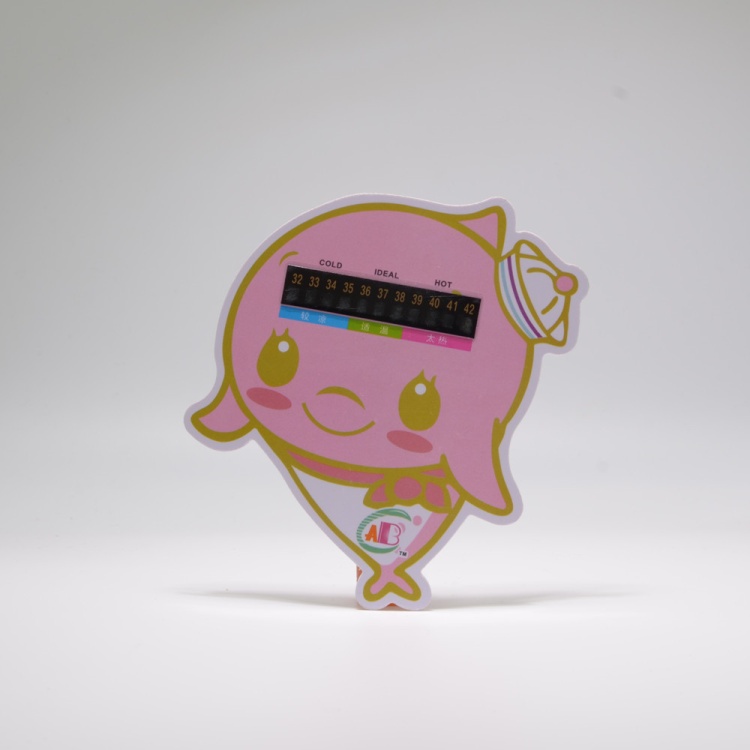
A liquid crystal thermometer uses temperature-sensitive liquid crystal formulations that reflect different colors as their temperature changes. These materials are commonly incorporated into thin, reversible indicator labels.
The important detail is that the indicator responds to its own temperature. It does not directly measure liquid through a container wall or remotely sense the object underneath it.
For a surface-mounted thermometer to provide a useful reading, heat must travel through the surface-to-label interface and the label construction until the sensing layer approaches the local surface temperature.
A strip attached to a bottle measures the thermal conditions at its mounting location. Its reading may approximate the contents under suitable conditions, but the two temperatures are not automatically identical.
Differences become more likely when:
- The contents are heating or cooling rapidly.
- The container wall is thick or insulating.
- Outdoor air is much colder or warmer than the contents.
- The label sits above the liquid level.
- The container has a double wall or insulating air gap.
This explains why a correctly functioning thermometer can still provide an unsuitable estimate of internal temperature.
Three related properties determine much of the behavior: thermal conductivity, thermal mass, and contact quality.
Thermal conductivity describes how readily heat passes through a material. Many common metals conduct heat more readily than glass, ordinary plastics, or wood.
However, conductivity alone does not determine performance. A thin plastic wall may respond faster than a much thicker structure made from another material. Material grade, geometry, and operating conditions also matter.
Thermal mass describes how much energy an object needs to change temperature. A thick container can take longer to heat or cool than a lightweight one.
Consequently, a slow-changing thermometer reading may reflect a slowly changing surface rather than a slow sensor.
Material selection should therefore consider both conductivity and the amount of material between the temperature source and the label.
Even a highly conductive metal surface can produce disappointing results if the label lifts at the edges or bridges over texture.
Thermal contact resistance is the resistance to heat flow across the interface between two surfaces. Air pockets, uneven adhesion, and unsuitable adhesive thickness can increase that resistance.
A reliable installation needs consistent contact across the active sensing area—not merely enough adhesion to prevent the label from falling off.
The following comparison describes typical application behavior. It is not a universal ranking or a substitute for testing the finished product.
| Surface material | Typical behavior | Main concern | Practical priority |
|---|---|---|---|
| Aluminum or steel | Often transfers heat effectively to the label | Local hot spots, coatings, curvature | Validate mounting position |
| Glass | Can support useful external monitoring | Wall thickness and inside-to-outside differences | Compare with contents during actual use |
| Common plastics | Performance varies substantially | Polymer type, thickness, adhesion | Test the exact container grade |
| Ceramic | Strongly dependent on construction | Thick walls and textured finishes | Choose a smooth, representative area |
| Wood or foam | Often weakly coupled to an internal heat source | Insulating structure and roughness | Use only for a clearly defined surface measurement |
| Painted or laminated surfaces | Depends on the complete layer stack | Added thermal resistance and coating stability | Validate the finished surface |
Metal often provides favorable conditions for a liquid crystal temperature strip. Nevertheless, the temperature may vary considerably across a metal component.
A label near a heater, seam, weld, or cooling airflow may indicate a genuine local temperature that does not represent the rest of the equipment.
For process checks, define the intended measurement location before choosing the label size and temperature range.
Glass-mounted liquid crystal thermometers are familiar in aquarium and container applications.
For liquid monitoring, position the strip on a representative area below the normal liquid level. Avoid locations directly beside heaters, cooling devices, or strong sunlight.
A reading taken immediately after adding hot or cold liquid should not be treated as a confirmed bulk-liquid temperature. The liquid, glass, and indicator need time to approach stable thermal conditions.
"Plastic" covers many materials with different thermal and adhesive properties.
Polypropylene, polyethylene, PET, and other polymers should not be treated as interchangeable mounting surfaces. Some are also more challenging for pressure-sensitive adhesives.
For an OEM project, identify the exact resin, surface finish, wall thickness, and any release agents or surface treatments. A successful sample on one plastic container does not establish performance on another.
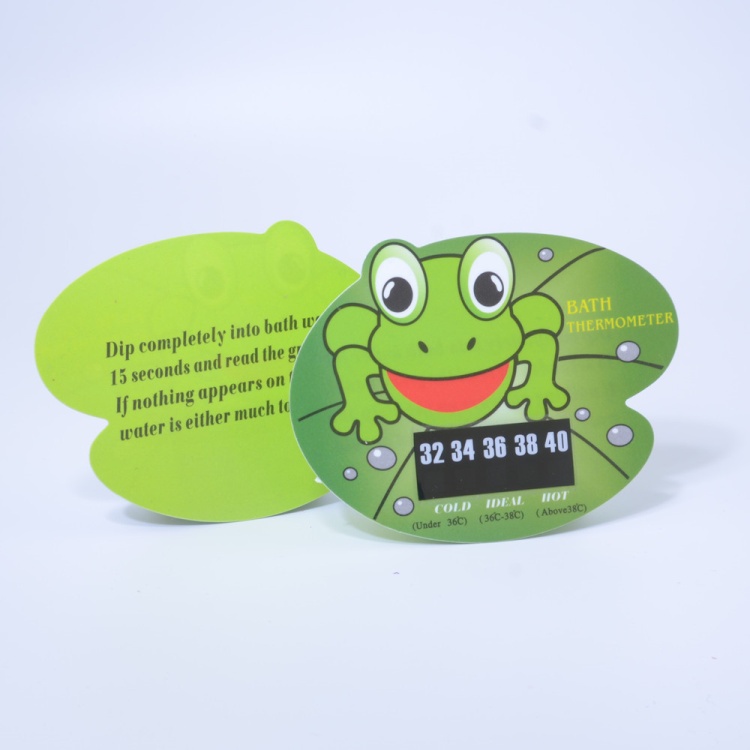
The substrate underneath the label is only part of the thermal pathway.
Embossing, ribs, brushed textures, and tight curves can prevent full contact.
A long strip wrapped around a small bottle may lift or wrinkle. A smaller indicator or different orientation may provide better contact, provided the sensing layout remains readable.
The appropriate solution is application testing—not simply specifying a stronger adhesive.
A label on painted steel measures through the paint layer. Powder coating, protective films, and decorative laminates introduce additional interfaces.
These layers may create response delays or temperature differences when heat is flowing through the assembly.
Validate the thermometer on the finished product rather than assuming that results from bare material will transfer unchanged.
Liquid crystal labels are contact indicators, so they do not infer temperature from the target's infrared emissivity.
However, surface color still matters under radiant heating. A dark container in sunlight may reach a different temperature from a light-colored container.
The label's own optical construction also matters. Conventional liquid crystal indicators commonly use a black background to make their reflected colors visible.
A useful specification separates three questions:
1. How close is the indication to the reference temperature under specified conditions?
2. How long does the installed indicator take to respond?
3. What temperature increments can the user distinguish?
A printed scale with small increments does not automatically provide equally small measurement uncertainty.
Published commercial specifications illustrate why product-specific data matters: one reversible liquid crystal strip family specifies ±2°C accuracy, while other constructions specify different tolerances.
These figures describe particular products—not a universal tolerance for every liquid crystal thermometer, and not a performance claim for our products.
For purchasing decisions, request the applicable accuracy, test conditions, scale increments, and interpretation instructions for the proposed construction.
The most useful qualification test evaluates the label on the actual product.
Decide whether the indicator should show:
- Local surface temperature.
- An approximate liquid temperature.
- A user-comfort range.
- A process operating band.
Set acceptance criteria around that objective. Avoid asking a surface label to provide an unvalidated internal-temperature measurement.
Use production-equivalent substrates, coatings, adhesives, and label constructions.
Apply labels to clean, dry surfaces using a substrate-compatible cleaning method. Avoid unapproved solvents, abrasive preparation, or added thermal paste.
Follow the adhesive supplier's application and conditioning instructions.
Use a calibrated, suitable reference instrument.
For surface performance, compare with a properly mounted contact sensor near the label while checking for local temperature gradients.
If the intended claim concerns liquid temperature, measure the liquid separately. Record both values so that wall effects are not mistaken for indicator error.
Evaluate stable temperatures first, then realistic heating and cooling cycles.
Include expected airflow, humidity, handling, condensation, and mounting orientation.
Do not impose a universal waiting time. Determine stabilization from the product's instructions and observed behavior.
A practical test record includes:
| Test item | What to record |
|---|---|
| Substrate | Material grade, finish, and wall thickness |
| Installation | Label position, application method, conditioning |
| Environment | Ambient temperature, airflow, moisture |
| Temperature comparison | Label indication and reference readings |
| Dynamic behavior | Delay during heating and cooling |
| Durability | Edge lift, color readability, adhesion changes |
Consider a hypothetical bottle filled with warm liquid in a cool room. The external strip reads lower than an immersed reference probe.
That difference does not immediately prove that the strip is inaccurate.
Several effects may contribute:
- The outside wall has not yet warmed fully.
- Room air cools the exposed label and bottle.
- The label sits partly above the liquid level.
- A thick wall separates the indicator from the liquid.
- Incomplete adhesion weakens thermal contact.
I would first check placement and adhesion, then compare the local wall temperature with the liquid temperature over time.
This separates three different problems: indicator performance, installation quality, and whether the surface is a suitable proxy for the contents.
A useful customization brief should describe more than artwork and dimensions.
For OEM/ODM development, provide:
- The exact mounting material and surface finish.
- Container geometry and available label area.
- Operating temperature range and required increments.
- Whether the target is surface or internal temperature.
- Indoor, outdoor, wet, or cleaning exposure.
- Required service life and acceptance criteria.
Protective layers also need evaluation. They can improve abrasion resistance or environmental protection, but they become part of the thermal construction.
Liquid crystal products should be protected from exposure conditions outside their specifications, including damaging ultraviolet light, excessive temperatures, and incompatible chemicals.
Reliable liquid crystal thermometer readings begin with the complete application: substrate, mounting position, adhesive, environment, and measurement objective.
Contact Qingdao Focus On Color Industry & Trade Co., Ltd. with your surface specifications, temperature range, dimensions, and intended use. Our OEM/ODM and personalized customization services can support development of a liquid crystal thermometer configuration for evaluation on your actual product.
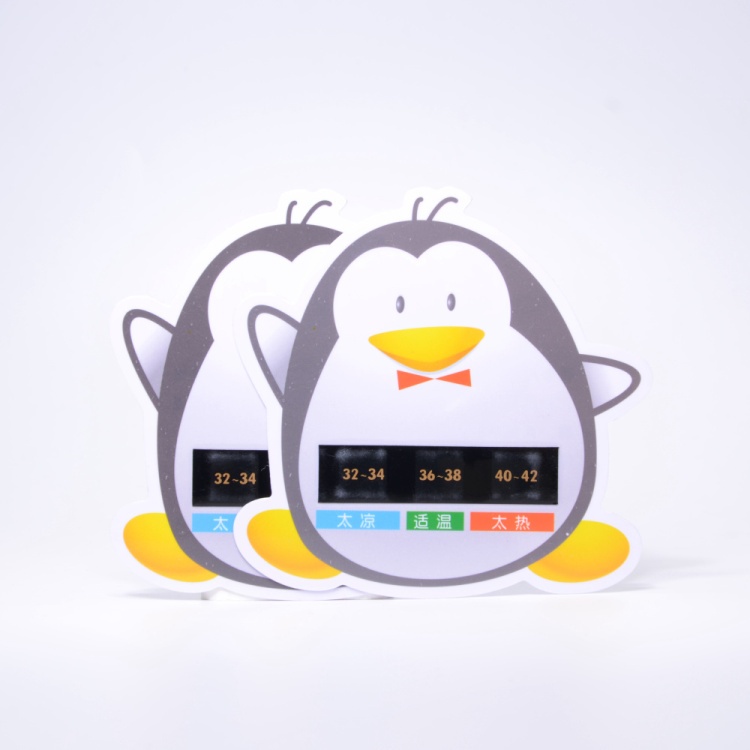
They can provide useful surface readings on suitable plastics. Performance depends on the polymer, wall thickness, adhesive contact, environment, and specified tolerance. Validate the finished assembly.
No. Metal often transfers heat effectively, but thickness, coatings, geometry, and heat-source location also influence response. A material name alone cannot predict installed performance.
It measures conditions at the outside mounting location. It may approximate water temperature, but glass thickness, room conditions, placement, and changing water temperature can create differences.
The temperature may be outside the active range, or lighting and viewing conditions may make interpretation difficult. Damage or deterioration is also possible. Check the product instructions and compare with a suitable reference.
Green commonly identifies the rated temperature in conventional multicolor strips. Other formulations and graphic designs exist, so use the interpretation guide supplied for that specific product.
The color response may be reversible, but that does not mean the adhesive is repositionable. Removing a label can damage it or compromise contact. Confirm reuse requirements before ordering.
1. National Physical Laboratory. "Kelvin (K)." Explains contact measurement and the need for the sensor to reach the object's temperature. [npl.co]
2. National Physical Laboratory. *Thermal Diffusivity and Thermal Conductivity Measurement Using the Laser Flash Technique*, Report DEPC-MPE 018. Provides the technical basis for conductivity, diffusivity, and interface resistance. [eprintspublications.npl.co]
3. Hallcrest. *Handbook of Thermochromic Liquid Crystal Technology*, RT006 Rev. 01. Covers indicator construction, color interpretation, black backgrounds, and protective coatings. [spotsee]
4. OMEGA Engineering. "Reversible, Multi-Temperature Liquid Crystal Strips," RLC-50. Product-specific example of a published ±2°C accuracy specification. [au.omega]
5. OMEGA Engineering. "What Is and How Does a Thermocouple Work?" Discusses the importance of full contact in surface temperature measurement. [in.omega]
6. SpotSee. "Liquid Crystal Thermometers." Explains reversible indicator operation, typical applications, and environmental limitations. [spotsee]
7. OMEGA Engineering. "An Introduction to Temperature Labels." Includes guidance on clean, dry mounting surfaces for adhesion. [omega]


