+86 18560646018

Views: 268 Author: Focus Color Publish Time: 2026-11-22 Origin: Site


Content Menu
● Waterproof vs. Water-Resistant Thermometer: Key Differences
● What Makes a Waterproof Thermometer Suitable for Bath Use?
>> Water Protection Must Cover the Entire Exposed Product
>> Waterproof Does Not Mean Maintenance-Free
● Understanding IP Ratings for Bath Thermometers
>> IPX4, IPX7, and IPX8 Explained
>> Why a Higher Rating Is Not the Whole Answer
● Which Thermometer Is Better for Baby Bath Use?
>> What Temperature Should Baby Bathwater Be?
>> A Thermometer Does Not Replace Supervision
● Digital vs. Liquid Crystal Bath Thermometers
>> Liquid Crystal Bath Thermometers
● Three Performance Factors More Important Than the Label
>> 1. Accuracy Around the Intended Bathing Range
>> 2. Response Time and Water Mixing
>> 3. Readability During Real Use
● A Practical Six-Step Bath Temperature Check
● An OEM/ODM Buyer's Checklist for Bath Thermometers
>> Specify the Exposure Conditions
>> Request Evidence Matched to the Finished Product
>> Use an Application-Based Sample Evaluation
● Final Verdict: Which Is Better for Bath Use?
>> Can I leave a waterproof thermometer in the bath?
>> Is an IPX7 thermometer automatically suitable for baby baths?
>> Can a water-resistant thermometer measure bathwater?
>> Are liquid crystal bath thermometers waterproof?
>> Does waterproof mean more accurate?
>> Can I use a forehead thermometer to check bathwater?
A waterproof thermometer is generally the better choice for bath use when its instructions explicitly permit immersion. A water-resistant thermometer may tolerate splashes, but that does not automatically make it suitable for floating in a bathtub. When comparing a waterproof thermometer vs. water-resistant thermometer, the deciding factors are documented water protection, measurement performance, and intended use—not the wording on the packaging.
At Qingdao Focus On Color Industry & Trade Co., Ltd., our background includes more than 13 years of manufacturing experience across photochromic, thermochromic, liquid crystal thermometer, and fragrance products. From a manufacturing perspective, we recommend evaluating the complete product construction rather than treating "waterproof" as a universal guarantee.
This guide explains the differences, the limitations of common ratings, and what families and commercial buyers should check before choosing a bath thermometer.
"Waterproof" and "water-resistant" describe different expectations, but neither marketing term provides a complete technical specification.
A water-resistant product may withstand limited moisture exposure. A waterproof product may be designed for immersion, but only within stated conditions. Neither should be assumed suitable for unlimited underwater use.
| Comparison point | Waterproof thermometer | Water-resistant thermometer |
|---|---|---|
| Typical positioning | Designed for specified immersion conditions | Designed for specified moisture or splash exposure |
| Floating in bathwater | Suitable only when explicitly approved | Do not assume suitability |
| Whole-device immersion | Must be confirmed in the instructions | Often restricted or prohibited |
| Probe-style designs | Body and probe may have different protection | Probe may be immersible while display stays dry |
| Main purchasing check | Immersion depth, duration, temperature, and intended use | Exactly which components can get wet |
| Practical bath suitability | Usually preferable for in-water monitoring | Potentially suitable for controlled, brief measurements |
The most useful purchasing question is not "Which label sounds stronger?" It is: "What exposure has this exact model been designed and tested to tolerate?"
A thermometer contains more than a sensor. Digital designs may include a display window, housing seams, buttons, and a battery compartment.
Protection at one component does not prove protection everywhere.
For example, an immersible probe attached to a splash-resistant display is not equivalent to a fully immersible floating thermometer. It can still measure bathwater effectively, but the display must remain outside the water as instructed.
For continuous in-bath monitoring, look for clear approval covering the complete device in its normal operating configuration.
Seals can be affected by damage, contamination, or incorrect reassembly. Battery replacement may introduce a new leak risk if a cover is not properly secured.
Before each use, inspect the product for:
- Cracks or separated housing seams.
- Loose or damaged battery covers.
- Moisture behind the display.
- Peeling layers on laminated indicators.
- Unstable readings or an unclear temperature scale.
Stop using a damaged thermometer rather than relying on its original protection claim.
An IP rating describes an enclosure's protection against ingress under specified test conditions. It does not independently verify temperature accuracy or suitability for baby bathing.
| Rating | General meaning | What bath buyers should understand |
|---|---|---|
| IPX4 | Protection against splashing water | Not an immersion rating |
| IPX7 | Protection against temporary immersion under defined conditions | Commonly summarized as approximately 1 meter for 30 minutes for small enclosures |
| IPX8 | Protection for continuous immersion under specified conditions | Check the manufacturer's declared depth, duration, and limitations |
| IP67 | Dust-tight enclosure with numeral-7 water protection | Dust protection does not increase immersion capability |
| IP68 | Dust-tight enclosure with numeral-8 water protection | Actual immersion conditions remain product-specific |
The "X" means a solids-protection rating has not been specified in that position; it does not mean the device necessarily has no dust protection.
Immersion protection does not automatically establish resistance to every other exposure.
Do not assume that an immersion-rated thermometer is also suitable for strong water jets, dishwasher cleaning, boiling water, bath oils, or cleaning chemicals. Check those conditions separately.
Likewise, a laboratory immersion result is not a lifetime guarantee. For bath use, the manufacturer's instructions should connect the protection claim to the intended water temperature, cleaning method, and operating conditions.
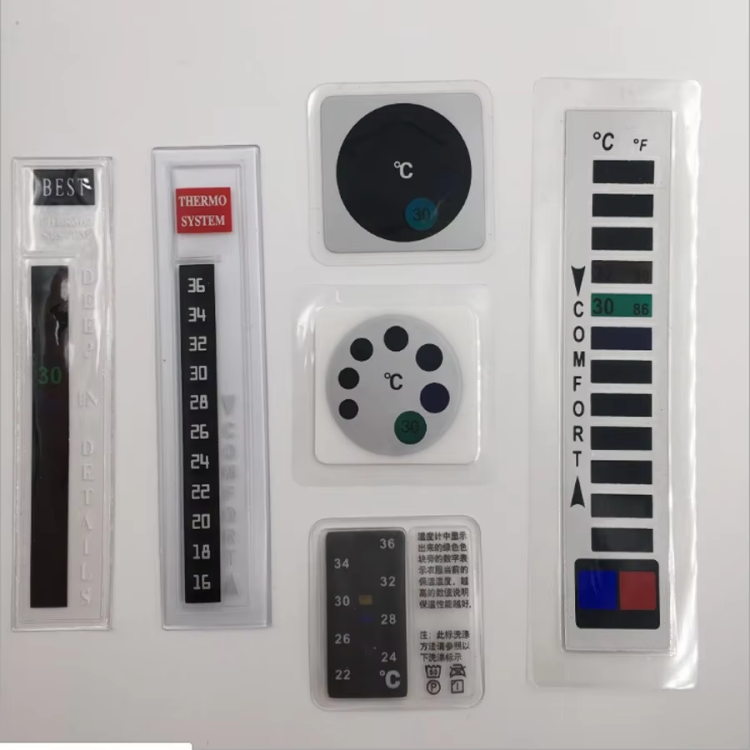
For a device that will float or remain in the water, choose a thermometer specifically designed for bathwater immersion. A generic splash-resistant room thermometer is not a substitute.
Common child-health guidance recommends approximately 37–38°C for babies and young children. Mayo Clinic advises aiming for around 38°C, or approximately 100°F.
Newborn guidance can differ. Ireland's Health Service Executive advises around 36°C for newborns and 37–38°C for babies and children. Follow your maternity team's or pediatric clinician's advice when individual circumstances require it.
These figures refer to the bathwater—not the hot-water supply.
Guidance limiting hot water at the faucet to around 49°C is a scald-prevention measure, not a recommended bathing temperature.
Check that the water feels warm, not hot, with your wrist or elbow before placing a baby in the bath.
Keep supplies within reach and maintain continuous, close supervision. A temperature alarm cannot prevent drowning, support a baby's head, or detect every hot area in unmixed water.
The thermometer is one safety aid within a broader bathing routine.
Water protection and sensing technology are separate decisions. Both electronic and liquid crystal products require construction appropriate to their intended exposure.
Digital thermometers can offer numerical readings, and some models include alarms or floating housings.
Check:
- Accuracy near normal bathing temperatures.
- Time needed for a stable reading.
- Sensor position when floating.
- Display visibility in a humid bathroom.
- Battery-compartment security.
- Cleaning and storage instructions.
A screen displaying tenths of a degree is not necessarily accurate to one-tenth of a degree. Display resolution and measurement accuracy are different specifications.
Liquid crystal indicators use temperature-responsive materials that change their visible appearance. They can provide a battery-free temperature indication, depending on the design.
However, not every liquid crystal strip is intended for direct immersion. A surface-mounted strip may indicate the temperature of the surface to which it is attached rather than directly measuring the surrounding water.
For bath applications, verify:
- Whether direct water contact is permitted.
- The indicated temperature range and increments.
- How to interpret the colors.
- The required reading position.
- The durability of protective layers and edges.
A decorative color change alone should not be treated as a calibrated temperature measurement.
Ask for accuracy data near the temperatures the product will actually measure.
A broad operating range does not establish good performance around 37–38°C. Likewise, a printed scale with many numbers does not prove that each reading is dependable.
For commercial procurement, request model-specific specifications rather than borrowing claims from a similar-looking product.
A thermometer needs time to respond after moving between environments.
Reading it immediately after taking it from a cool room may produce a misleading result. Follow the specified stabilization time.
Water distribution matters too. A sensor measures conditions at its location, not the entire bathtub. Mix the water thoroughly before checking, and do not position the thermometer beside a running hot-water outlet.
A technically capable thermometer can still be difficult to use with wet hands and limited attention.
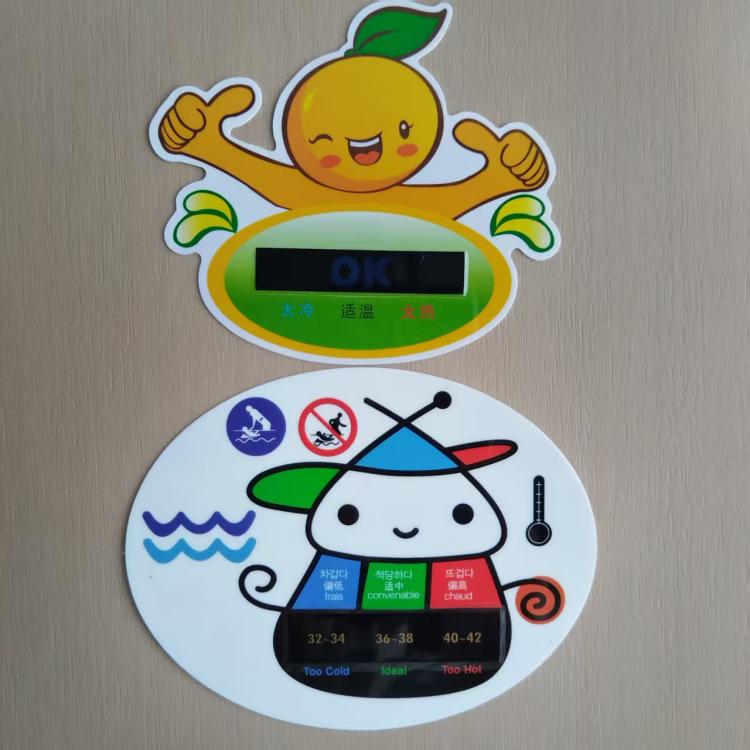
Evaluate whether a caregiver can quickly identify the reading under ordinary bathroom lighting. For color-changing products, assess the clarity of the legend and temperature boundaries.
For digital products, check viewing angle, contrast, and whether essential warnings remain understandable without relying on color alone.
Use this routine alongside the product instructions and relevant child-health guidance:
1. Prepare towels, toiletries, and clothing before starting.
2. Fill the bath and turn off the taps before placing the baby in the water.
3. Mix the water thoroughly to reduce localized hot areas.
4. Position the thermometer as directed and wait for the reading to stabilize.
5. Confirm the temperature and check that the water feels warm with your wrist or elbow.
6. After bathing, clean, dry, and store the thermometer according to its instructions.
If the reading seems implausible, pause. Recheck the water and the device rather than choosing whichever result feels more reassuring.
For brands, distributors, and promotional-product buyers, a reliable specification should describe how the product performs—not simply how it looks.
At Qingdao Focus On Color Industry & Trade Co., Ltd., we provide OEM/ODM and personalized customization services. Our recommendation is to define the intended use before finalizing graphics, packaging, or temperature messaging.
Document whether the product will:
- Float throughout bathing.
- Be dipped briefly and removed.
- Attach to a tub surface.
- Experience repeated warm-water exposure.
- Contact approved soaps or other bath additives.
Each scenario creates different validation requirements.
Ask for available documentation covering:
- The exact model and construction.
- Water-exposure test conditions.
- Accuracy and response-time methods.
- Cleaning limitations.
- Label and instruction consistency.
- Applicable requirements in the destination market.
A material supplier's report does not automatically validate the finished thermometer.
Before placing a volume order, agree on a sample evaluation protocol.
Compare readings against a suitable reference thermometer in well-mixed water around the intended operating range. Repeat the assessment after representative exposure and approved cleaning cycles.
This is a proposed procurement method—not a claim that any particular model has already passed those tests. Acceptance limits and test conditions should be agreed before evaluation begins.
For a thermometer that will stay in bathwater, an immersion-approved waterproof thermometer is generally the better choice.
A water-resistant model can still work when its approved probe measures the water while the vulnerable display remains dry. The distinction depends on the complete product design and instructions.
Choose documented immersion suitability, appropriate accuracy, clear readings, and practical maintenance over a stronger-sounding label.
Planning a customized bath-temperature product? Contact Qingdao Focus On Color Industry & Trade Co., Ltd. with your target market, temperature range, preferred format, branding requirements, and intended water exposure. We can discuss OEM/ODM options and the product-specific validation needed before production.
Only if its instructions permit that use. Check immersion duration, water-temperature limits, and whether the product is designed to float or remain submerged.
No. IPX7 addresses temporary immersion protection. It does not independently establish measurement accuracy, child-related product safety, or approval for repeated warm, soapy-water exposure.
Yes, if its approved sensing component can contact the water. Keep non-immersible parts dry and follow the stated insertion depth and measurement procedure.
Some are designed for immersion; others are surface indicators. Check the finished product's instructions rather than assuming all liquid crystal strips have the same protection.
No. Water protection concerns resistance to ingress. Accuracy concerns how closely the indicated temperature matches the actual temperature under specified conditions.
Do not assume so. Use it only if the manufacturer explicitly provides a suitable water or object-measurement mode and instructions. A body-temperature reading mode is not interchangeable with bathwater measurement.
1. International Electrotechnical Commission. "IP ratings." Official explanation of enclosure ingress-protection classifications and IEC 60529. [iec]
2. D.L.S. Electronic Systems, Inc. "IPX7 and IPX8 Immersion Testing." Overview of temporary and continuous immersion testing. [dlsemc]
3. Raising Children Network. "What's a safe bath temperature for babies and young children?" Guidance on bathing temperatures and scald prevention. [raisingchildren.net]
4. Mayo Clinic. "Baby bath basics: A parent's guide." Guidance on bathwater temperature, temperature checks, and supervision. [mayoclinic]
5. Health Service Executive, Ireland. "Water safety in the home." Bath preparation and temperature guidance, including newborn considerations. [www2.hse]
6. American Academy of Pediatrics, HealthyChildren.org. "Bathing Your Baby." Bath preparation, faucet-temperature precautions, and infant bathing safety. [healthychildren]
7. American Academy of Pediatrics, HealthyChildren.org. "Infant Drowning Prevention & Water Safety: How to Protect Your Baby." Close-supervision guidance. [healthychildren]
8. Scientific Instrument Services. "Telatemp Liquid Crystal Thermometers." Technical information illustrating liquid crystal surface-temperature indication and product-specific specifications. [sisweb]


