+86 18560646018

Views: 298 Author: Focus Color Publish Time: 2026-11-23 Origin: Site


Content Menu
● How Do Aquarium Thermometer Stickers Work?
>> What Does the Sticker Actually Measure?
>> Are Temperature Changes Reversible?
● Choose Aquarium Thermometer Stickers Using These Six Criteria
>> 1. Match the Temperature Range to the Aquarium
>> 2. Separate Scale Resolution from Accuracy
>> 3. Prioritize Clear, Interpretable Displays
>> 4. Check Adhesive and Surface Compatibility
>> 5. Distinguish Splash Resistance from Submersibility
>> 6. Evaluate Instructions Alongside the Product
● Aquarium Thermometer Stickers vs. Other Monitoring Options
● How to Install an Aquarium Thermometer Sticker Correctly
>> Step 1: Select a Representative Location
>> Step 2: Clean and Dry the Surface
>> Step 3: Apply the Strip Smoothly
>> Step 4: Allow the Reading to Stabilize
>> Step 5: Compare with an Independent Thermometer
● How to Read a Liquid Crystal Aquarium Thermometer
● A Practical Three-Stage Verification Method
>> Stage 1: Establish a Baseline
>> Stage 2: Check Under Normal Daily Conditions
>> Stage 3: Define When to Investigate
● OEM/ODM Buying Guide for Aquarium Brands and Distributors
>> Build a Written Product Specification
>> Validate Samples Before Approving Artwork and Production
>> Customize Around the User's Task
● Choose a Thermometer Sticker You Can Verify
>> 1. Are Aquarium Thermometer Stickers Accurate Enough?
>> 2. Do Aquarium Thermometer Stickers Go Inside or Outside?
>> 3. Can Aquarium Thermometer Stickers Be Used on Acrylic Tanks?
>> 4. Why Are Two Temperatures Showing Different Colors?
>> 5. How Long Does an Aquarium Thermometer Sticker Last?
>> 6. Can a Sticker Detect Overnight Overheating?
Aquarium thermometer stickers provide a simple, battery-free way to check tank temperature. However, choosing a reliable strip takes more than comparing prices or finding an attractive design. The temperature range, scale spacing, adhesive quality, installation position, and reading instructions all influence how useful the result will be.
At Qingdao Focus On Color Industry & Trade Co., Ltd., our manufacturing perspective starts with a practical question: can the user understand the temperature display and recognize when further checking is necessary? With more than 13 years of production experience across color-changing and related products, we support OEM/ODM projects and personalized customization.
This guide explains how to choose aquarium thermometer stickers for everyday fishkeeping—and how brands, wholesalers, and aquarium-product suppliers can specify better products.
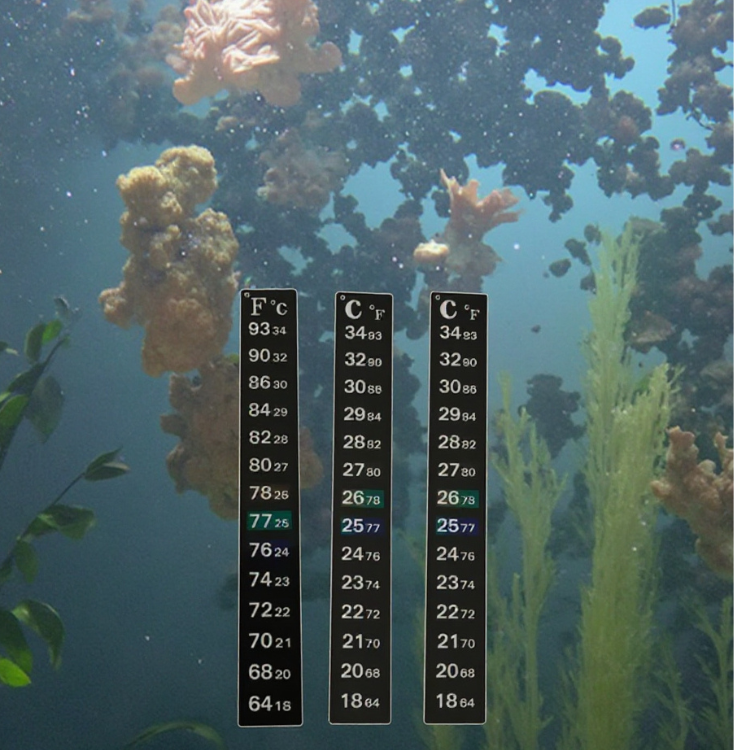
Most color-changing aquarium thermometer strips use thermochromic liquid crystals. These temperature-sensitive materials change their reflected color as their temperature changes. Manufacturers arrange them into individual indicators associated with printed temperature values.
Unlike an electronic thermometer, a conventional liquid crystal strip needs no battery, screen, or submerged probe.
An externally mounted sticker responds to the temperature at the aquarium's outer surface. It does not directly measure water temperature.
This distinction matters. Heat must pass through the tank wall before the indicator responds, while surrounding air can also influence the outside surface. Consequently, the reading may differ from the water temperature, particularly during rapid changes or unfavorable installation conditions.
Treat a sticker as a convenient visual indicator, not an automatic substitute for a verified in-water thermometer.
Conventional aquarium liquid crystal strips are reversible: their colors change as the temperature rises and change back as it falls.
They normally indicate the current temperature rather than recording the highest or lowest temperature reached. A normal reading in the morning therefore cannot prove that the aquarium stayed within range overnight.
Start with the requirements of the animals being kept. There is no single ideal temperature for every tropical, coldwater, freshwater, or marine aquarium.
Choose a strip that covers the intended operating range with useful space above and below it. A target temperature at the very end of the scale makes developing problems harder to interpret.
For example, a strip covering 18–36°C may suit some warm-water applications, but it cannot meaningfully display temperatures below its lower limit. This is an example of range selection, not a universal aquarium recommendation.
Resolution describes the spacing between displayed values. Accuracy describes how closely the indication agrees with a suitable reference under specified conditions.
A strip with 1°C increments is not automatically accurate to ±1°C. Likewise, a digital thermometer displaying tenths of a degree is not necessarily accurate to that level.
For purchasing decisions, ask:
- What accuracy applies to this exact model?
- Over which temperature range?
- Under what mounting and environmental conditions?
- How was performance checked?
Some commercial liquid crystal products specify ±1°C across an aquarium-relevant range. That specification must not be assumed for every aquarium sticker or every installed tank.
An unreadable thermometer offers little practical protection.
Look for:
- Numerals large enough for the intended viewing distance.
- Strong contrast between the scale and background.
- Adequate spacing between indicators.
- Clear Celsius and Fahrenheit identification.
- Instructions explaining the actual color sequence.
For dual-scale products, check that the two scales are easy to distinguish. A crowded layout can increase reading mistakes even when the sensing material performs correctly.
Reliable surface contact matters because the strip must respond to the tank wall.
Ask whether the adhesive is intended for glass, acrylic, or both. Confirm installation requirements, storage conditions, and whether the product is designed for one-time application.
Do not assume a strip can be peeled off and reused. Repositioning can introduce dirt, bubbles, curling, or incomplete contact.
For aquarium brands, adhesion testing should include representative cleaning routines and incidental splashes—not simply a successful application to one clean sample.
A product used beside an aquarium may encounter condensation and splashes. That does not make it suitable for underwater installation.
Check the manufacturer's stated exposure limits. Unless the model is explicitly designed for immersion, install a conventional adhesive thermometer strip outside the tank.
Similarly, confirm which cleaners are compatible. Strong solvents can damage liquid crystal products or their protective construction.
Instructions are part of the monitoring system, not an optional packaging detail.
Useful instructions explain:
- Where the sticker belongs.
- How to prepare the surface.
- How to interpret multiple colored indicators.
- What a blank display might mean.
- When to verify the reading independently.
For private-label products, clear instructions can help prevent avoidable installation errors and customer complaints.
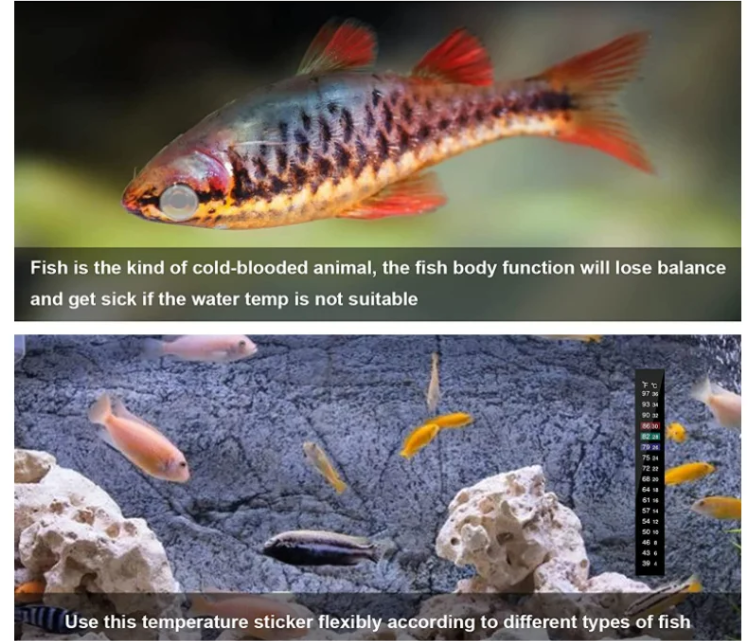
The best thermometer depends on the task, not simply its format.
| Monitoring option | Main advantage | Important limitation | Suitable role |
|---|---|---|---|
| Liquid crystal sticker | Battery-free, compact visual display | Measures the external surface; affected by installation | Routine visual checks |
| Submerged liquid-in-glass thermometer | Measures temperature within the water | Requires readable placement and secure mounting | Independent water-temperature checks |
| Digital thermometer with submerged probe | Convenient numerical display | Accuracy depends on the instrument and probe placement | Routine monitoring and cross-checking |
| Monitoring system with logging or alarms | Can reveal excursions between manual checks | Requires appropriate setup and verification | Higher-consequence or closely managed systems |
A practical approach is to combine a visible sticker with an independently checked in-water thermometer.
The sticker makes frequent observation convenient. The second instrument helps confirm unexpected readings before adjustments are made.
Choose an accessible section of the outside tank wall that remains below the waterline and above the substrate.
Avoid:
- Direct sunlight.
- Heating vents and strong drafts.
- External heat sources.
- Areas immediately beside the aquarium heater.
- Locations hidden by equipment or furniture.
Where practical, position the thermometer away from the heater, such as toward the opposite end of the aquarium. The goal is a useful tank reading rather than a localized warm spot.
Remove dirt, grease, and residue using a method compatible with the aquarium material and the sticker's instructions.
Dry the application area fully. Avoid introducing cleaning products into the aquarium.
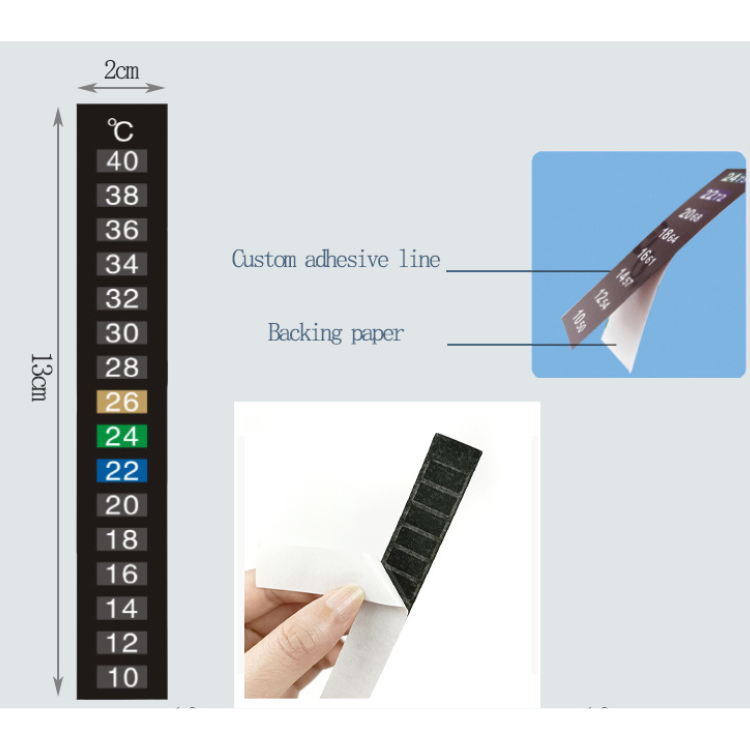
Peel the backing away carefully. Press the sticker evenly against the surface, avoiding wrinkles and trapped air.
Do not cover sensing areas with decorative film or other labels unless the manufacturer approves that arrangement.
Follow the product's stated stabilization guidance.
Avoid judging performance immediately after application, a large water change, or a sudden room-temperature change. The tank wall and indicator need time to approach a stable condition.
Check the sticker against a suitable in-water thermometer after conditions stabilize.
If they disagree, investigate placement, reference-instrument accuracy, scale interpretation, and environmental influences before adjusting the heater.
For many liquid crystal strips, green identifies the indicated temperature. Adjacent indicators may show other colors when the temperature lies between scale points.
Some manufacturers instruct users to interpret a reading between illuminated tan and blue indicators when green is absent. However, color conventions and printed layouts vary, so the instructions supplied with the particular strip take priority.
If the display is unclear:
1. View it under neutral, adequate lighting.
2. Check that the expected temperature lies within its range.
3. Confirm full contact with the tank surface.
4. Consult the model-specific color guide.
5. Verify the water temperature independently.
Do not interpret a completely dark strip as proof of a safe temperature.
A useful monitoring routine checks more than whether one sample appears correct once.
After installation and stabilization, record the sticker indication and an independently checked water-temperature reading.
Note the room conditions and installation position. This establishes a comparison point rather than claiming laboratory calibration.
Repeat the comparison at different times during ordinary aquarium operation.
Do not deliberately expose fish to temperature extremes for testing. Instead, observe whether normal changes in lighting, room conditions, or heater operation affect agreement.
Decide in advance which observations require confirmation:
- An unexpected temperature change.
- A reading close to the livestock's acceptable limits.
- Persistent disagreement between instruments.
- Faded colors or lifting edges.
- Unusual animal behavior.
The acceptable difference depends on the aquarium and the instruments involved. There is no universal tolerance appropriate for every species or monitoring task.
For commercial buyers, the most useful specification goes beyond dimensions and artwork.
| Specification | What to clarify |
|---|---|
| Temperature range | Intended aquarium application and display limits |
| Scale increments | Required readability and monitoring detail |
| Accuracy | Model-specific tolerance and test conditions |
| Tank compatibility | Approved materials and mounting conditions |
| Display design | Numeral size, units, contrast, and color guide |
| Adhesive performance | Application method and durability expectations |
| Packaging | Installation, storage, and reading instructions |
| Quality documentation | Sampling, traceability, and agreed acceptance criteria |
A sensible sample-review process checks low, middle, and high points within the intended operating range.
Evaluate the finished construction on representative tank material. Where possible, distinguish between controlled surface-temperature performance and agreement with aquarium water under realistic installation conditions.
These are related but different measurements. A sensing element can meet its surface-temperature specification while the installed strip still differs from the water.
Acceptance limits and sample quantities should be agreed before production. Proposed testing should never be presented as completed certification.
At Qingdao Focus On Color Industry & Trade Co., Ltd., we provide OEM/ODM and personalized customization across our product portfolio.
For an aquarium thermometer project, discuss temperature range, scale layout, branding, packaging, and application requirements together. Confirm model-specific feasibility and performance before final approval.
A larger logo should not come at the expense of readable numbers or clear installation instructions.
Reliable monitoring comes from combining a suitable product with correct installation, clear interpretation, and independent verification.
For brands and distributors, the strongest specification addresses the complete user experience—not just the printed temperature range.
Contact Qingdao Focus On Color Industry & Trade Co., Ltd. with your target market, operating range, scale preference, dimensions, branding requirements, and expected order quantity. Request samples and agree on a verification plan before committing to bulk production.
They can be useful for routine visual monitoring when appropriately specified, correctly installed, and independently checked. Their usefulness depends on the particular product and aquarium conditions. Verify critical readings with a suitable in-water instrument.
Conventional adhesive liquid crystal aquarium strips generally go outside the tank. Install them below the waterline on the exterior surface. Only immerse a model explicitly designed for underwater use.
Check the manufacturer's compatibility guidance. Do not assume that a strip intended for glass will provide the same adhesion or installed performance on acrylic, especially across different wall thicknesses.
The temperature may lie between adjacent indicators. Follow the supplied color-reading guide rather than assuming that the brightest or highest number is correct.
There is no universal replacement interval. Material construction, storage, ultraviolet exposure, heat, cleaning chemicals, and handling all matter. Replace a strip when readability, adhesion, or agreement with a suitable reference deteriorates.
An ordinary reversible strip does not retain temperature history. It shows its current indication when observed. Use a suitable minimum/maximum thermometer or logging system when unobserved excursions matter.
1. SpotSee. "Liquid Crystal Thermometers." Technical background on reversible liquid crystal indicators, color interpretation, model-specific accuracy, environmental limitations, and customization. [spotsee]
2. Scientific Instrument Services. "Telatemp Liquid Crystal Thermometers." Technical information on surface-temperature indication, green/tan/blue interpretation, temperature ranges, and specified accuracy. [sisweb]
3. Aqueon. "Fish Tank Heater Tips for Cold Weather." Manufacturer guidance on external thermometer placement, avoiding sunlight and heating sources, positioning away from the heater, and regular temperature checks. Its comparative claim about thermometer accuracy is not adopted in this article. [aqueon]
4. TradeIndia. "Liquid Crystal Fish Aquarium Thermometer — Qingdao Focus on Color Industry & Trade Co., Ltd." Supplier listing illustrating an 18–36°C product range, self-adhesive construction, and a stated model-specific accuracy. Listing specifications are not treated as independent performance verification. [tradeindia]
5. Alibaba. "Custom Liquid Crystal Self Adhesive Temperature Indicators — Qingdao Focus On Color Industry & Trade Co., Ltd." Supplier listing describing liquid crystal ink, PET, and adhesive construction. [alibaba]


