+86 18560646018

Views: 228 Author: Focus Color Publish Time: 2026-11-16 Origin: Site


Content Menu
● What Does a Liquid Crystal Thermometer Measure on a Fermenter?
● How to Choose the Right Range, Increments, and Display
>> Start with the temperatures that trigger an action
>> Separate display increments from accuracy
>> Make the display readable where it will be used
● How to Install and Read a Stick-On Fermenter Thermometer
● A Buyer's Pilot Test: Compare the Strip with a Reference Probe
>> Test stable readings and changing conditions separately
>> Set acceptance criteria before comparing samples
● What Makes a Fermentation Thermometer Strip Good Value?
● Request a Sample for Your Fermentation Application
>> Are stick-on liquid crystal thermometers accurate enough for fermentation?
>> Where should I place a fermentation thermometer strip?
>> Can I use the same strip on glass, plastic, and stainless steel?
>> What does it mean when two colors appear at once?
>> Can I wash or sanitize a fermenter with the strip attached?
>> Does a liquid crystal strip record overnight temperature changes?
Choose liquid crystal thermometers for fermentation temperature monitoring by matching the strip's range and display increments to the decisions you make during a batch. Then test it on the vessel your customers actually use. A stick-on fermenter thermometer offers good value when it gives operators a readable, repeatable surface reading without opening the vessel. It is not the right tool when you need to verify the temperature inside the liquid, trigger a controller, or maintain an automatic temperature record.
That distinction matters whether you are outfitting a homebrew setup, sourcing accessories for a fermentation kit, or specifying a private-label thermometer strip. The lowest unit price tells you little about how often the strip will need replacing or whether users will misread it. This guide shows how to compare specifications, test samples, and judge value before ordering.

A reversible liquid crystal thermometer uses temperature-sensitive materials that change color as the strip warms or cools. On a numeric model, the active color appears at one or more printed temperature marks. The strip requires no battery, and the display changes again as the temperature moves back through its range. "Reversible" describes that color response; it does not mean the adhesive is designed to be peeled off and reapplied.
A strip attached to the outside of a fermenter responds to the temperature at its mounting location. Placing it below the liquid line helps it represent the wetted wall rather than the headspace. Even there, it does not directly measure the liquid. Wall material and thickness, airflow, and external heating or cooling can all affect how closely the strip follows the contents.
The practical question is: what happens after someone reads it? If the reading prompts a routine check, an external strip may be enough. If it determines whether to change a temperature setpoint or accept a batch, use a suitable probe to verify the internal temperature. You can still keep the strip as a quick visual check.
Write down the normal operating window, the points at which an operator should investigate, and any colder or warmer stages the same strip needs to cover. Use the process or yeast supplier's guidance to establish those temperatures. A range printed on a retail thermometer is not a recommendation for every yeast strain or fermentation process.
Suppose a process normally runs at 18–22 °C and the operator needs to investigate below 17 °C or above 23 °C. A strip whose scale stops at 18 and 22 °C covers the target window but cannot show how far the vessel has moved beyond it. A candidate marked from 16 to 26 °C in 1 °C increments gives the operator more context on either side. Those figures illustrate how to select a scale; they are not a recipe.
You may still need a broader scale if the same label must remain useful through a colder finishing stage. Compare how well each candidate displays the marks used most often rather than choosing the broadest range by default.
A 1 °C increment means neighboring display marks are 1 °C apart. It does not establish that the strip is accurate to ±1 °C, and it tells you nothing about the difference between the fermenter wall and its contents. Ask the supplier for the stated tolerance, the conditions under which it was measured, and the display behavior between marks.
Likewise, do not assume that any two active cells can be averaged. Some models support an intermediate reading when specific adjacent colors appear; others use a different convention. Follow the instructions for the exact model. If two similar-looking models have different color rules, make sure the installation card and packaging match the one being shipped.
Choose Celsius or Fahrenheit based on the instructions the end user follows. A dual-scale strip can suit an international kit, but it is not an upgrade if the extra numbers make the reading harder to identify. Ask someone unfamiliar with the sample to read it in the intended lighting and from a normal working position. Then ask them to explain what a blank display means. That simple test can reveal a confusing layout or a missing instruction before you approve the artwork.
| Buying criterion | What to verify before ordering |
|---|---|
| Temperature range | The scale covers routine operation and the temperatures that trigger a check. |
| Display increments | Adjacent marks are close enough to support the intended decision. |
| Stated tolerance | The supplier identifies the tolerance, its test conditions, and any model-specific exceptions. |
| Color legend | Users can identify the active reading, interpret adjacent cells, and check a blank display. |
| Adhesive compatibility | The strip lies flat and stays bonded on the actual vessel finish and curvature. |
| Cleaning exposure | The complete label, not just the adhesive, withstands the expected exposure. |
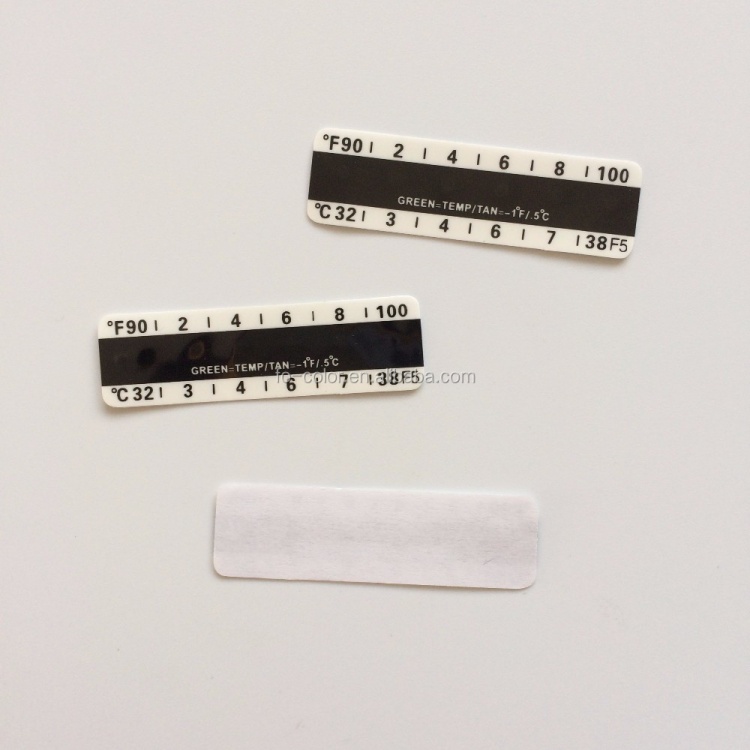
1. Choose a representative spot. Mount the strip on the outside wall, below the lowest liquid level expected during monitoring. Avoid seams, handles, direct sunlight, strong drafts, and spots directly over a heating belt or cooling surface.
2. Prepare the vessel. Follow the label supplier's surface preparation instructions. As a starting point, use a clean, dry area and check that the strip can sit flat without bridging a ridge or lifting at the edges.
3. Apply and read the strip. Press it evenly into place and allow the reading to settle before comparing it with another instrument. Use the supplied color legend. On many models, green identifies the active temperature mark, but that convention is not universal.
4. Investigate a blank or unexpected display. The temperature may be outside the printed range. Check the viewing light, mounting contact, and label condition as well. If the result would change an operating decision, verify it with a suitable probe.
5. Clean within the label's limits. A water-resistant strip may tolerate splashes or brief rinsing without being suitable for soaking. Before approving a model, check what the supplier says about the complete label's exposure to cleaners, sanitizers, and repeated wetting.
Before approving a bulk purchase, test the strip on the vessel it will be sold with or used on. A sample that looks clear on a flat display board may be harder to read on a curved bucket. Likewise, good adhesion on glass does not establish how it will perform on the textured plastic or coated metal in your kit.
Start with the intended vessel and a representative fill level. Use a reference probe with known accuracy to measure the liquid, either directly in a controlled test setup or through a thermowell, a closed fitting that separates the probe from the liquid. Record the strip and probe readings together near the lower, middle, and upper parts of the working range after temperatures have stabilized. Include the mounting location and surrounding conditions in your notes.
Then repeat the comparison while the vessel is warming or cooling under typical operating conditions. The difference during a change may not match the difference at a stable temperature. For instance, if the strip reads 20 °C and the liquid probe reads 21 °C at one stable point, that is a result for that setup—not a reason to add 1 °C to every future strip reading.
This comparison evaluates the installed system. It does not isolate the strip's manufacturing tolerance, because you are comparing a wall reading with a liquid reading. If you need to verify the label tolerance itself, ask the supplier for the test method and how the temperature at the label is referenced.
Define what would make a sample fail. Can a new user identify the reading without help? Does the label stay in place after the normal cleaning routine? At the temperatures that trigger an action, does the strip give a useful indication, or would the operator routinely have to second-guess it?
For a sourcing team, the useful output is a short approval record: vessel type, mounting position, sample identifier, test conditions, and pass or fail. Keep an approved sample and artwork proof so receiving staff can compare later shipments with what was tested.
Customer feedback about value for money points to a better purchasing question: what does each usable installation cost? Consider the delivered price, labels lost during application, replacements after cleaning, and the support needed when customers cannot interpret the display. A cheaper strip is not a saving if operators keep replacing it or checking it with another instrument because the scale is unclear.
Use a standard strip when its range, units, and adhesive already fit the application. Consider a custom strip when a change would solve a specific problem: larger numerals for a poorly lit installation, a shorter label for a curved fermenter, or a scale focused on the temperatures operators check most often. If users routinely mistake a blank display for a defective strip, an illustrated instruction card may add more value than a custom shape.
For OEM/ODM orders, ask suppliers to quote against the same requirements. Include the dimensions, scale and reading rules, target surface, cleaning exposure, packaging, sample cost, minimum order quantity, and lead time. Compare like for like. A quotation for a loose strip and one for an individually packaged strip with instructions do not represent the same finished product.
Qingdao Focus On Color Industry & Trade Co., Ltd. has more than 13 years of manufacturing experience and offers OEM/ODM and personalized customization for liquid crystal thermometers and other product lines. To request a sample and quotation, send your vessel material or a photo of the mounting area, working temperature range, desired increments, preferred units, cleaning routine, artwork needs, and estimated order quantity. Ask for the proposed reading legend and tolerance alongside the sample, so your team can assess usability and cost before approving production.
They can be suitable for routine visual checks if the installed strip tracks the process closely enough for the intended decision. Verify that relationship on your own vessel. Use a suitable probe when an internal temperature reading is needed for control, documentation, or batch acceptance.
Choose a clean, dry spot on the outside wall below the lowest expected liquid line. Avoid direct airflow, sunlight, and areas immediately next to heating or cooling equipment. Use the same location on comparable vessels if you want to compare their readings.
Some models are sold for all three materials, but adhesion and reading behavior should be checked on each actual vessel. Surface texture, wall construction, and curvature matter. A sample that works on a smooth glass carboy should not automatically be approved for a textured plastic bucket.
It depends on the model. On some strips, a specified combination of adjacent colors indicates a temperature between the two marks. Use the exact product legend rather than assuming every multicolor display should be averaged.
Follow the product's cleaning limits. Water resistance does not establish that the label can be submerged or repeatedly exposed to sanitizer. If routine cleaning involves soaking, ask the supplier for documented compatibility and confirm it in your pilot test.
No. A reversible strip shows the current condition within its display range; it does not provide a time-stamped record. Use a temperature logger or a controller with logging if you need to see what happened between manual checks.
- [SpotSee — Liquid Crystal Thermometers]. Technical background on reversible color changes, temperature indication, stated accuracy, and customizable formats. [spotsee]
- [DwyerOmega — RLC-80 Reversible Temperature Liquid Crystal Strips]. Product specifications illustrating how scale spacing and color conventions can vary by model. [dwyeromega]
- [MoreBeer — Adhesive Temperature Strip Thermometer]. Commercial example of a stick-on fermentation thermometer marketed for glass, plastic, and metal vessels. [morebeer]
- [MoreBeer — Brewing Thermometers]. Examples of brewing thermowells, probe-based temperature control, and digital monitoring options. [morebeer]
- [North Mountain Supply — Fermometer Adhesive Strip Thermometer]. Model-specific guidance on reading adjacent colors, water resistance, and prolonged exposure to cleaning solutions. [northmountainsupply]


