+86 18560646018

Views: 257 Author: Focus Color Publish Time: 2026-11-18 Origin: Site


Content Menu
● How Magnetic Bookmarks and Corner Bookmarks Hold a Page
>> Magnetic bookmarks fold over a page edge
>> Corner bookmarks slide over the tip of a page
● Magnetic Bookmarks vs. Corner Bookmarks: Side-by-Side Comparison
● What Works Best for Different Textbooks and Thick Books?
>> For textbooks carried between classes, prioritize retention without protrusion
>> For desk-based reference books, prioritize page access and legibility
>> For thin, brittle, or valuable pages, consider neither
● A Five-Minute Bookmark Fit Test Before You Buy in Bulk
● How to Mark Multiple Chapters Without Bulking Up the Book
● What to Specify When Ordering Custom Bookmarks
>> When a specialty finish adds value
>> 1. Are magnetic bookmarks better for thick hardcover books?
>> 2. Do magnetic bookmarks leave marks on textbook pages?
>> 3. Do corner bookmarks fall off in a backpack?
>> 4. Can a bookmark hold several pages at once?
>> 5. Which bookmark is easier to make for a classroom activity?
>> 6. What should I send a supplier to compare custom designs?
Magnetic bookmarks are the better starting point for textbooks that travel in a backpack. Corner bookmarks are the better starting point for books that mostly stay on a desk, especially if you want a simple paper marker you can make yourself. But in the comparison of magnetic bookmarks vs. corner bookmarks for textbooks and thick books, page count is rarely the deciding factor. A 900-page hardcover with sturdy paper may be easier to mark than a 300-page reference book with thin sheets, curled corners, and diagrams printed close to the edge.
My rule of thumb: choose the bookmark for the page it touches and the way you use the book. Then test it in the book itself. A marker that feels secure in your hand can still hide a page number, catch on a notebook, or leave an impression after the cover closes.

A folding magnetic bookmark has two sides that meet across the paper. You open the marker, position it over a page edge, and let the sides come together. It does not need to sit at a corner, so you can move it along the top or outer edge to avoid a diagram, heading, or handwritten note. Some models use a printed arrow to point to a line or paragraph.
That freedom of placement is especially useful in textbooks with crowded margins. The trade-off is that the fold and the magnetic material add thickness at one spot. A compact marker can be a good fit for a thick textbook, but a larger one is not automatically better. It may stick farther out, cover more print, or make the book harder to close naturally.
A traditional corner bookmark is a small sleeve or pocket that slips over a page corner. It can be folded from paper or made as a printed piece. It stays in place through the fit of the pocket rather than magnetic attraction. A smooth, well-fitting sleeve is easy to remove, but a loose pocket can slide off, and a tight one can bend the corner during installation.
Unlike a magnetic marker, a corner bookmark cannot move inward along the page edge. That matters when the corner contains a page number, section label, or part of an illustration. A shallow pocket can leave more content visible, but it still needs enough depth to stay seated.
| Buying or reading criterion | Magnetic bookmark | Corner bookmark |
|---|---|---|
| How it stays in place | Two sides meet across the page | A sleeve fits over the page corner |
| Carrying a book in a backpack | A low-profile design is a good first candidate; test for snagging | A loose or protruding pocket may slide off or catch |
| Placement flexibility | Can move along a suitable page edge | Limited to a page corner |
| Thin or fragile paper | Check for impressions and whether the marker opens without pulling the sheet | Check whether insertion bends or creases the corner |
| Closure with several markers | Folded markers can create a raised spot if stacked | Layered pockets can build up at the same corner |
| Quick DIY use | Requires magnetic components and an outer construction | A basic version can be folded from paper |
| Custom printing | Two faces can carry different graphics or instructions | The visible shape can support illustrations, mascots, or color coding |
These are design trade-offs, not universal performance ratings. A slim paper pocket may close more neatly than a bulky magnetic clip, while a snug corner bookmark may hold better than a poorly made magnetic one. Compare finished samples, not just product categories.
For a commuting student, I'd start with a slim magnetic bookmark that extends only as far as needed to find the page. Fit it on a single representative sheet, close the textbook, and slide the book into the bag alongside whatever normally travels with it. If the bookmark catches on a binder or moves when the book comes out, change the placement or try a shorter design before opting for a stronger grip.
A paper corner bookmark is a practical choice for a cookbook, desk dictionary, or reference volume that stays in one place. You can make several in different colors and assign them to recurring sections. Before making a set, check whether the pocket covers the folio—the printed page number—or a running heading. If every usable corner contains information you need, a narrow magnetic bookmark placed along a clear part of the outer edge makes more sense.
If a page wrinkles as you separate it from its neighbors or already has a tear at the corner, don't use that spot to test a tight pocket or a magnetic grip. For a fragile or valuable volume, a loose, thin paper slip is a more conservative starting point. When inspecting a thick binding, support the covers rather than pressing the book flat just to install a bookmark. The goal is to find your place again without making the book harder to handle.
There is no need to rely on product photos alone. This quick comparison is a proposed screening method, not a laboratory standard. If you are selecting bookmarks for a school, bookstore, or publisher, use a book that represents the thinnest paper you expect customers to mark, as well as a book that represents their usual carry conditions.
1. Check the fit. Put each sample on a different, comparable page. Fit the magnetic marker across the edge without dragging it. Slide the corner pocket on without pinching the tip. Note any buckling or resistance.
2. Close the book. Let the cover settle under its own weight. Look across the page edges for a visible gap or raised area. Repeat with the number of markers readers are likely to use.
3. Recreate normal handling. Lift the closed book, move it between the desk and a shelf, or put it into a typical bag and take it out. Note whether either marker shifts, snags, or falls off.
4. Reopen and inspect. Remove each bookmark by opening the magnetic faces or sliding the pocket off gently. Look for impressions, bent corners, scuffs, and any information the marker had covered.
5. Make the decision repeatable. Record the book type, marker size, position, and result. For a bulk order, keep the approved sample so you can compare it with production units.
If the two styles perform equally well, choose the one readers can find and remove more easily. For longer-term use, repeat the check after leaving the marked book closed overnight; a quick fit test only shows what happens during short handling.

In a thick book, placement matters as much as the number of markers. Four bookmarks spread across clear areas need not behave like four bookmarks stacked over the same top corner. Overlapping markers concentrate the extra material in one spot, which is where you are most likely to notice a gap when the cover closes.
- Use one marker for your current reading position and others only for sections you revisit.
- Stagger magnetic bookmarks along available edges rather than lining them up at one point.
- With corner bookmarks, alternate between clear upper and lower corners where the page layout and pocket orientation allow.
- If your system depends on color, add numbers or symbols so you can still distinguish markers when the colors look similar.
- If several markers already make the book visibly uneven, use fewer and keep a short index of the remaining page numbers.
For example, a student using a thick anatomy textbook could put a magnetic bookmark beside the current reading passage and use two color-coded corner bookmarks for review sections, provided their corners are clear. The two styles can work together; they don't need to compete for every page.
A good custom bookmark brief starts with the book and the reader, not the artwork. Specify the intended book trim size, page stock or a representative sample, daily use, and expected number of markers per book. For a magnetic bookmark, ask for folded dimensions and finished thickness. For a corner bookmark, ask for pocket depth, the orientation of the opening, and a sample showing how far the design reaches across printed content.
Review the artwork at actual size. On a folding magnetic design, check that both faces read in the intended direction and that important text stays clear of the fold. On a corner design, determine which parts of the logo, illustration, or chapter label will remain visible once the pocket is installed. Review a finished sample in an actual book before approving a production run.
A color-changing design can make sense for a science textbook promotion, bookstore campaign, or gift set when the effect serves a clear purpose. A photochromic detail, which changes appearance with light exposure, could reveal a secondary graphic. A thermochromic detail, which responds to temperature, could demonstrate a concept from a lesson. Keep page indicators and essential brand text legible whether or not the effect is active, and review the finish under the conditions readers will actually encounter.
Qingdao Focus On Color Industry & Trade Co., Ltd. brings more than 13 years of production experience to specialty products, including photochromic and thermochromic products, liquid crystal thermometers, and fragrance products. For an OEM/ODM project, send your target book dimensions, a representative page sample or layout, artwork, requested quantity, and preferred finish. Ask the team to assess feasibility and review a prototype against your fit criteria before approving production.
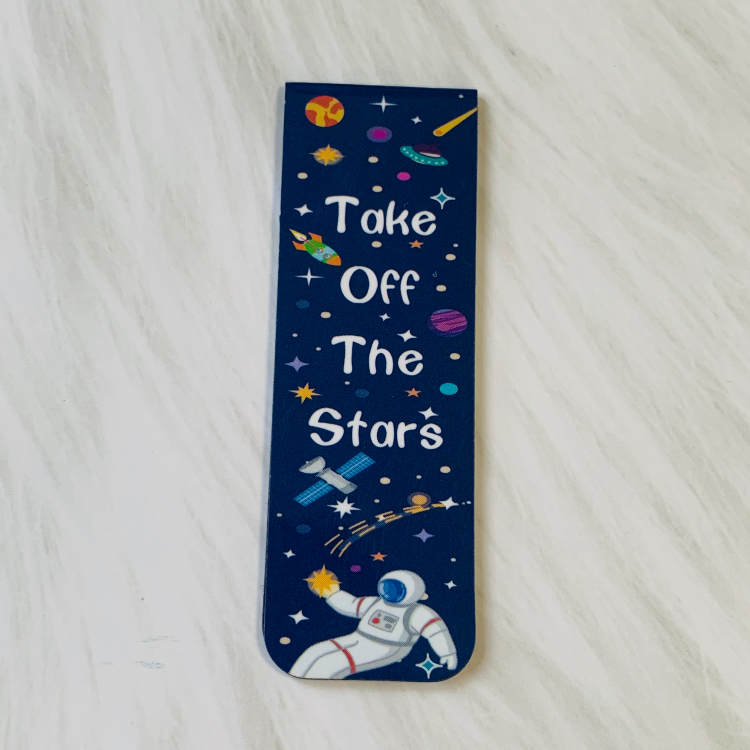
They are a useful choice when the book travels frequently or when you need to position a marker away from the corner. Hardcover thickness alone does not determine suitability. Check how the marker sits on the individual page and whether the cover closes without creating a raised spot.
They can leave an impression if the paper is thin or the marker presses heavily at one point. Test on a comparable, noncritical page first. When removing it, open the two faces rather than pulling the closed marker along the paper.
They can if the sleeve is loose or catches on another item. A closer fit can improve retention, but it should not require enough force to bend the corner. Test the fitted sample by packing and unpacking the book as you normally would.
Some magnetic bookmarks can, but it depends on the design and the thickness of the sheets. A corner pocket sized for one page may buckle a small stack. If section marking is the goal, mark the first page of the section rather than trying to grip every page in it.
A folded paper corner bookmark is the simpler starting point. It can be made from one square of paper and decorated after folding. Keep raised embellishments away from the part that sits between the pages so the book can close more evenly.
Send the book's height and width, a page sample or paper specification, a photo of the intended placement, artwork, expected order quantity, and the typical use case. Request finished samples of both styles if you are undecided, then evaluate them in the same book.
- [Peter Pauper Press — Owls i-clips Magnetic Page Markers]. Primary product example for the folding magnetic design and printed position arrow. It is not a comparative performance test. [peterpauper]
- [Red Ted Art — How to Make an Origami Corner Bookmark]. Step-by-step demonstration of a single-sheet folded paper corner pocket. [redtedart]
- [Library of Congress — Preserving Your Books: Handling Your Books]. Preservation guidance on supporting book covers and avoiding the need to force a binding flat. [guides.loc]
- [Library of Congress Preservation Directorate — Printable Materials]. Examples of printable paper bookmarks from a preservation education program. [loc]


