+86 18560646018

Views: 231 Author: Focus Color Publish Time: 2026-11-06 Origin: Site


Content Menu
● How Does an Aquarium Sticker Thermometer Work?
>> Surface Temperature Is Not Identical to Water Temperature
● Why Is My Aquarium Sticker Thermometer Not Working? A Quick Diagnosis
● 1. The Water Temperature Is Outside the Strip's Range
>> What to Do
● 2. You Are Misreading the Liquid Crystal Colors
>> How to Read an Aquarium Thermometer Strip
● 3. The Sticker Has Poor Contact With the Glass
● 4. The Thermometer Is in the Wrong Position
● 5. The Strip Has Not Reached a Stable Reading
● 6. Light, Heat, or Chemicals Have Damaged the Strip
>> Can a Damaged Strip Be Repaired?
● A Practical Comparison Test Before You Replace It
>> Step 1: Establish a Reference
>> Step 2: Stabilize the Conditions
>> Step 3: Record the Comparison
>> Step 4: Interpret the Pattern
● Accuracy, Resolution, and Placement Error Are Different
● A Manufacturer's Checklist for Better Aquarium Temperature Strips
● Get a Temperature Strip Designed for Your Application
>> Why Is My Aquarium Thermometer Sticker Completely Black?
>> Does an Aquarium Thermometer Sticker Go Inside or Outside?
>> Why Does My Strip Show Two Temperatures?
>> Can I Move My Aquarium Temperature Sticker?
>> Are Sticker Thermometers Accurate Enough for Aquariums?
>> Should I Replace a Sticker That Never Changes?
"Why is my aquarium sticker thermometer not working?" If your temperature strip looks black, shows several colored numbers, or disagrees with another thermometer, it does not necessarily mean it is broken. The cause may be an out-of-range temperature, poor contact with the glass, unsuitable placement, confusing color interpretation, or deterioration of the temperature-sensitive material.
Verify the water temperature with a suitable in-water thermometer before adjusting your heater. A blank strip cannot tell you whether the aquarium is too hot, too cold, or simply difficult to read.
At Qingdao Focus On Color Industry & Trade Co., Ltd., our manufacturing perspective starts with a practical distinction: a liquid crystal strip responds to the temperature of the surface touching it. Understanding that relationship helps separate installation problems from genuine product failure.
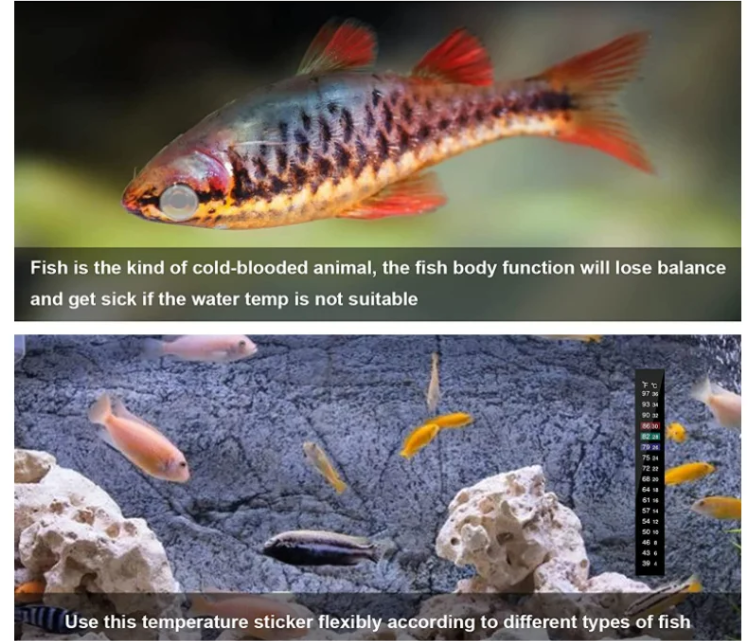
Most traditional aquarium temperature stickers contain thermochromic liquid crystals. These materials change the wavelengths of light they reflect as their temperature changes, making different numbers or indicator blocks appear colored.
Unlike a digital thermometer, a conventional liquid crystal strip does not need a battery, electronic sensor, or reset button.
Its temperature response is normally reversible. As the surface warms or cools, the display changes accordingly. However, each strip has a defined operating range. Outside that range, the temperature-sensitive indicators may look black.
A typical aquarium strip attaches to the outside of the glass. It senses the local glass surface rather than directly measuring the water.
That makes three factors important:
- Heat transfer from the water through the aquarium wall.
- Full contact between the strip and the glass.
- Exposure to room air, sunlight, or nearby heat sources.
A working strip can therefore disagree with an immersed thermometer without either device necessarily being completely defective.
Start by matching the symptom to a likely explanation.
| What you see | Possible explanation | What to check first |
|---|---|---|
| The entire strip looks black | Temperature outside its range, poor visibility, or material deterioration | Compare water temperature with the printed scale |
| Two adjacent numbers show colors | Temperature falls between marked values | Follow the manufacturer's color instructions |
| The reading seems unusually high | Sunlight, nearby heating, or actual overheating | Verify using an immersed thermometer |
| The reading seems unusually low | Cool airflow, unsuitable position, or actual cooling | Check placement and water temperature |
| The display changes slowly | Surface equilibration, placement, or limited scale resolution | Allow stable conditions before comparing |
| Corners are lifting | Adhesive failure or contamination | Inspect contact across the sensing area |
| The display remains patchy | Uneven contact or possible physical deterioration | Check for bubbles, creases, and damage |
This table is a starting point, not proof of a specific fault. The most reliable next step is a controlled comparison.
An aquarium thermometer strip cannot display temperatures beyond its printed limits.
For example, a strip marked from 18°C to 30°C cannot provide a useful numerical reading at 15°C or 33°C. Both conditions may produce a dark-looking display, depending on the product.
That creates an important troubleshooting trap: black does not automatically mean cold.
1. Read the lowest and highest temperatures printed on the strip.
2. Measure the water with a suitable independent thermometer.
3. Compare that measurement with the strip's operating range.
4. Address any confirmed temperature problem according to the requirements of your aquarium's inhabitants.
Do not turn the heater up simply to make a number appear.
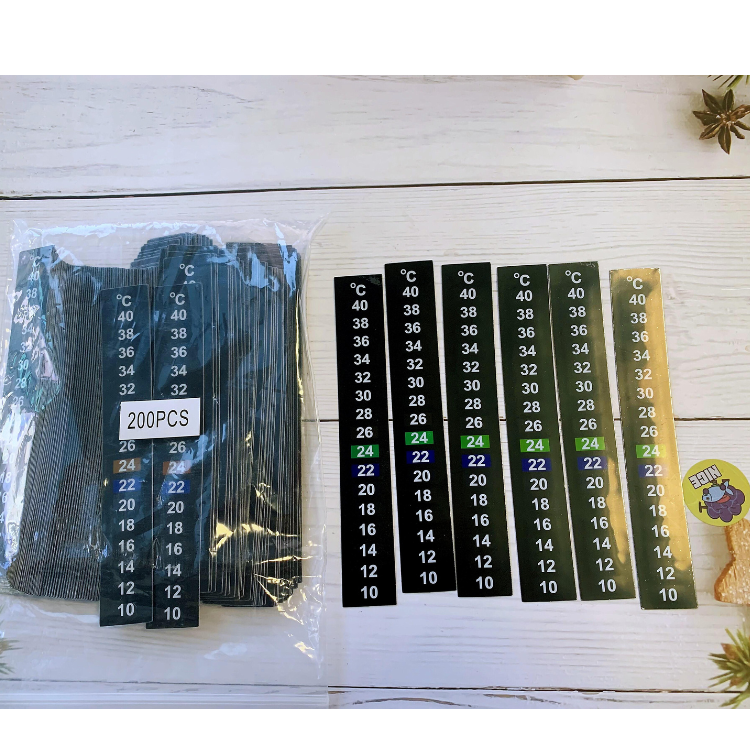
Several illuminated numbers do not necessarily indicate a malfunction. Adjacent elements can display different colors when the temperature falls between marked values.
Many liquid crystal strips use green to identify the indicated temperature. Some manufacturers explain intermediate readings through neighboring tan or brown and blue indicators.
However, color conventions and printed legends vary. Follow the instructions supplied with your specific strip rather than applying a universal "blue means cold" rule.
- View the strip under adequate white light.
- Identify the relevant Celsius or Fahrenheit scale.
- Look for the color specified as the reading color.
- If two adjacent indicators appear, consult the product's interpolation instructions.
- Avoid claiming precision finer than the scale supports.
A strip with widely spaced markings cannot reliably communicate the same detail as an instrument designed for finer measurement.
A temperature strip needs good thermal contact with its mounting surface. Dust, grease, trapped air, residual adhesive, and lifting edges can interfere with that contact.
This is why a sticker that appears attached may still give an unreliable reading: the adhesive can hold around the edges while leaving part of the sensing area separated from the glass.
For a new strip:
1. Select an accessible area of exterior glass.
2. Clean the surface using a method compatible with the aquarium and adhesive.
3. Allow it to dry completely.
4. Apply the strip flat, following its installation instructions.
5. Avoid wrinkles and air pockets.
Keep cleaning products away from aquarium water. Do not add an improvised adhesive layer beneath the sensing area unless the manufacturer approves it.
If an existing strip is lifting, replacement may be more dependable than repeatedly pressing it back into place.
Placement can create a misleading reading even when the liquid crystal material works correctly.
For standard exterior aquarium strips, choose glass backed by water. Avoid placing the sensing area above the waterline or behind substrate where it does not represent the intended water zone.
Aqueon recommends positioning its stick-on thermometer outside the glass, just above the gravel, away from direct sunlight and other heat sources, preferably opposite the heater.
- Direct sunlight.
- Nearby radiators or furnace vents.
- Strong cooling drafts.
- Areas directly influenced by external heat sources.
- Curved or uneven surfaces that prevent full adhesion.
If you relocate a strip, check whether it is designed for repositioning. Peeling a single-use adhesive product can damage its bond or sensing layer.
After installation, a water change, or a substantial temperature adjustment, the glass and strip may need time to approach stable conditions.
There is no universal waiting time for every aquarium sticker thermometer. Product construction, aquarium-wall properties, and surrounding conditions all matter.
Follow the manufacturer's response-time guidance. For troubleshooting, compare readings only after the aquarium is reasonably stable.
Avoid "testing" the strip by warming it with your fingers. That introduces body heat and does not demonstrate whether it accurately represents aquarium water temperature.
Likewise, do not use boiling water, a hair dryer, or a freezer to force a response. These tests can exceed the product's specified conditions.
Liquid crystal indicators are reusable within their intended conditions, but they are not immune to deterioration.
Manufacturers identify ultraviolet exposure, high temperatures, and strong solvents as factors that can shorten product life or damage performance.
Possible warning signs include:
- A faded or unusually weak display.
- Clouding or separation of layers.
- Cracks, creases, or scratches across sensing elements.
- Persistent patchiness despite proper mounting.
- No useful response under verified, in-range conditions.
A conventional liquid crystal thermometer has no electronic reset procedure. Reattaching a loose edge cannot restore degraded temperature-sensitive material.
Also, do not assume every strip has the same service life. Storage life, installed life, sunlight exposure, and adhesive durability are separate considerations. Ask for the specification for the actual product rather than relying on a generic replacement interval.
From a troubleshooting perspective, the most useful question is not simply "Does the sticker change color?" It is "Does it provide a consistent, understandable indication under its intended conditions?"
Use a suitable immersed aquarium thermometer with a stated accuracy. A digital display alone does not guarantee accuracy.
Position its sensing area near the strip's water-side location without touching the heater, glass, or substrate.
Avoid comparing immediately after feeding-related maintenance, a water change, heater adjustment, or moving the aquarium.
Check both instruments according to their response-time instructions.
Use a simple observation log:
| Observation | Sticker indication | Reference reading | Conditions |
|---|---|---|---|
| First stable check | Record visible colors and numbers | Record temperature | Note sunlight or airflow |
| Second stable check | Record again | Record again | Keep placement unchanged |
| Later check | Record again | Record again | Note any environmental change |
A difference that changes with drafts or sunlight suggests environmental influence. A persistent blank display at a verified in-range temperature makes damage or poor contact more plausible.
Do not average conflicting readings and assume the result is correct. Investigate the discrepancy.
These three concepts explain many complaints about aquarium sticker thermometer accuracy.
- Accuracy describes agreement with a reference under stated conditions.
- Resolution describes the smallest displayed increment.
- Placement error arises when the measured location does not represent the temperature you intended to measure.
A Farnell-hosted technical datasheet specifies ±1°C tolerance for many of its covered liquid crystal products, with exceptions. That is a specification for those products—not a universal guarantee for aquarium stickers or for this company's products.
Likewise, a 1°C scale does not automatically mean ±1°C accuracy. Display spacing and measurement tolerance are different characteristics.
For buyers, the practical lesson is to request both the temperature increment and the stated accuracy, together with the conditions under which that accuracy applies.
For aquarium brands, distributors, and private-label buyers, preventing complaints begins before production.
A useful product specification should address:
- Temperature range suited to the intended application.
- Clearly printed Celsius, Fahrenheit, or dual scales.
- Understandable color-reading instructions.
- Adhesive compatibility with the intended mounting surface.
- Readability under normal aquarium lighting.
- Storage conditions and packaging protection.
- Defined accuracy and response-time requirements.
- Clear limits on immersion and repositioning.
Sample evaluation should assess more than appearance. Check adhesion, display clarity, and temperature indication under agreed conditions before approving a bulk order.
Qingdao Focus On Color Industry & Trade Co., Ltd. brings more than 13 years of manufacturing experience across photochromic, thermochromic, liquid crystal thermometer, and fragrance product categories, with OEM/ODM and personalized customization services.
For a customized aquarium strip, confirm the required temperature range, artwork, mounting conditions, and acceptance criteria with our team. Performance claims should match the approved specification.
A useful aquarium thermometer combines readable indicators, suitable materials, correct placement, and clear instructions.
Contact Qingdao Focus On Color Industry & Trade Co., Ltd. to discuss OEM/ODM aquarium thermometer strips. Share your target temperature range, scale preference, dimensions, branding, order quantity, and intended market so our team can review a suitable customization brief.
The temperature may be outside its operating range, the lighting may make it difficult to read, or the strip may have poor contact or damage. Verify water temperature independently before changing heater settings.
A conventional adhesive liquid crystal aquarium strip generally mounts outside the glass. Follow the specific product instructions; do not assume an exterior adhesive strip is suitable for immersion.
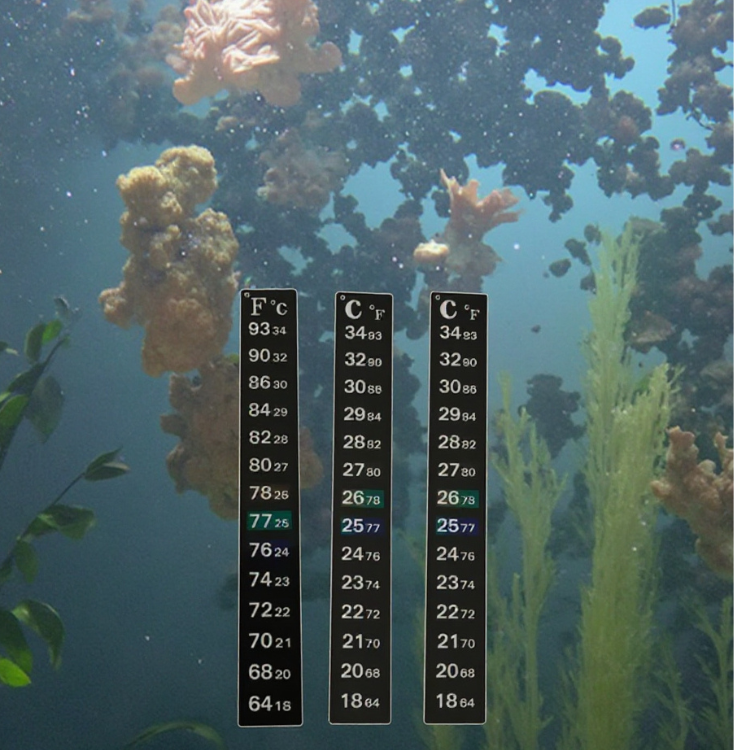
The surface temperature may fall between adjacent indicators. Use the manufacturer's color-reading guide to interpret the display rather than treating both numbers as separate measurements.
Only if the product is designed for repositioning. Peeling can weaken adhesion or damage the layers. A fresh strip is often the more dependable option when a single-use product needs relocation.
They can provide convenient visual monitoring when correctly specified and installed. Where narrow temperature control matters, verify readings with an appropriate in-water instrument rather than relying on an unconfirmed surface indication alone.
First confirm that the water temperature actually changes enough to cross a printed increment. If the strip remains unresponsive under verified in-range conditions, inspect contact and damage, then replace it if necessary.
1. [Aqueon — Fish Tank Heater Tips for Cold Weather]. Aquarium thermometer placement, avoiding external heat sources, and routine temperature checks. [aqueon]
2. [Thermographics — Liquid Crystal Thermometers]. Operating principles, reversible color changes, reading guidance, and sensitivity to ultraviolet light, heat, and solvents. [thermographics]
3. [Thermochromic Liquid Crystal Reversible Temperature Indicators — Technical Datasheet, hosted by Farnell]. Product-specific tolerances, color interpretation, scale increments, and custom manufacturing parameters. [farnell]
4. [DwyerOmega — 16 Label Reversible Liquid Crystal Strips]. Examples of defined operating ranges, display increments, and reversible indicators. [dwyeromega]
5. [SpotSee — Liquid Crystal Q&A]. Passive operation, temperature-dependent optical response, and reversible versus irreversible indicators. [spotsee]


